Operational AI Risk Reduction for the Enterprise
Organizations are deploying AI faster than they can govern it. The result: unauthorized data exposure, hallucinated outputs, unauditable decisions, and compounding operational risk. Atlas™ is the governance and control layer that sits above the models — reducing AI risk at the infrastructure level so enterprises can safely operationalize AI at scale.
How Atlas™ Reduces Operational AI Risk
Enterprises fear lawsuits, compliance violations, data exposure, and reputational damage from ungoverned AI. Atlas™ provides three operational primitives that reduce those risks at the infrastructure level — before any AI output reaches a user or a system.
Govern — prevent unauthorized exposure
Every AI interaction is identity-scoped, retrieval-bound, and policy-mediated before any output is generated. This eliminates unauthorized data access, cross-boundary retrieval, and ungoverned model interactions — the largest source of enterprise AI risk.
Prove — eliminate hallucinations and false outputs
Every response is grounded in authorized source evidence with confidence scoring and citation lineage. No fabricated citations. No invented policy language. No wrong contract recommendations. The evidence chain is the proof.
Control — make every AI decision auditable
Responses are operationally classified (Approved, Escalated, Blocked) and routed through human review where required. The complete transaction is serialized into an immutable audit ledger — reducing compliance exposure, legal liability, and regulatory risk.
That's it. Govern. Prove. Control. Everything else is implementation detail.
The Market Has Shifted — From "How Do We Use AI?" to "How Do We Control It?"
Initially organizations asked how to use AI. Now they are asking how to audit it, how to prevent exposure, how to prove compliance, and how to reduce liability. That shift is the market. And the infrastructure to answer those questions does not exist yet.
"What are the escalation requirements for high-risk diabetic patients?"
The AI returns an answer. It looks correct. But the organization cannot verify:
This is the default state of enterprise AI today. The model works — but the operational risk is invisible, compounding, and unauditable.
A Governance Layer Between the Model and the Operation
Atlas™ sits between your enterprise documents, your AI infrastructure, and your users. Every query is mediated — identity-checked, retrieval-scoped, policy-enforced, operationally classified, and permanently audited — before any answer is delivered.
"What are the escalation requirements for high-risk diabetic patients?"
Before the answer is returned, Atlas™ mediates every step:
The clinician gets the same answer — but the organization now has operational proof of access, evidence, governance, classification, and lineage.
Operational Workflow
AI + Governance + Workflow + Approvals + Auditing
A real-world contract analysis workflow inside Atlas™ — from user request through governed retrieval, AI analysis with risk scoring, human review and approval, to audited response delivery. Not just AI chat. Governed operational intelligence.
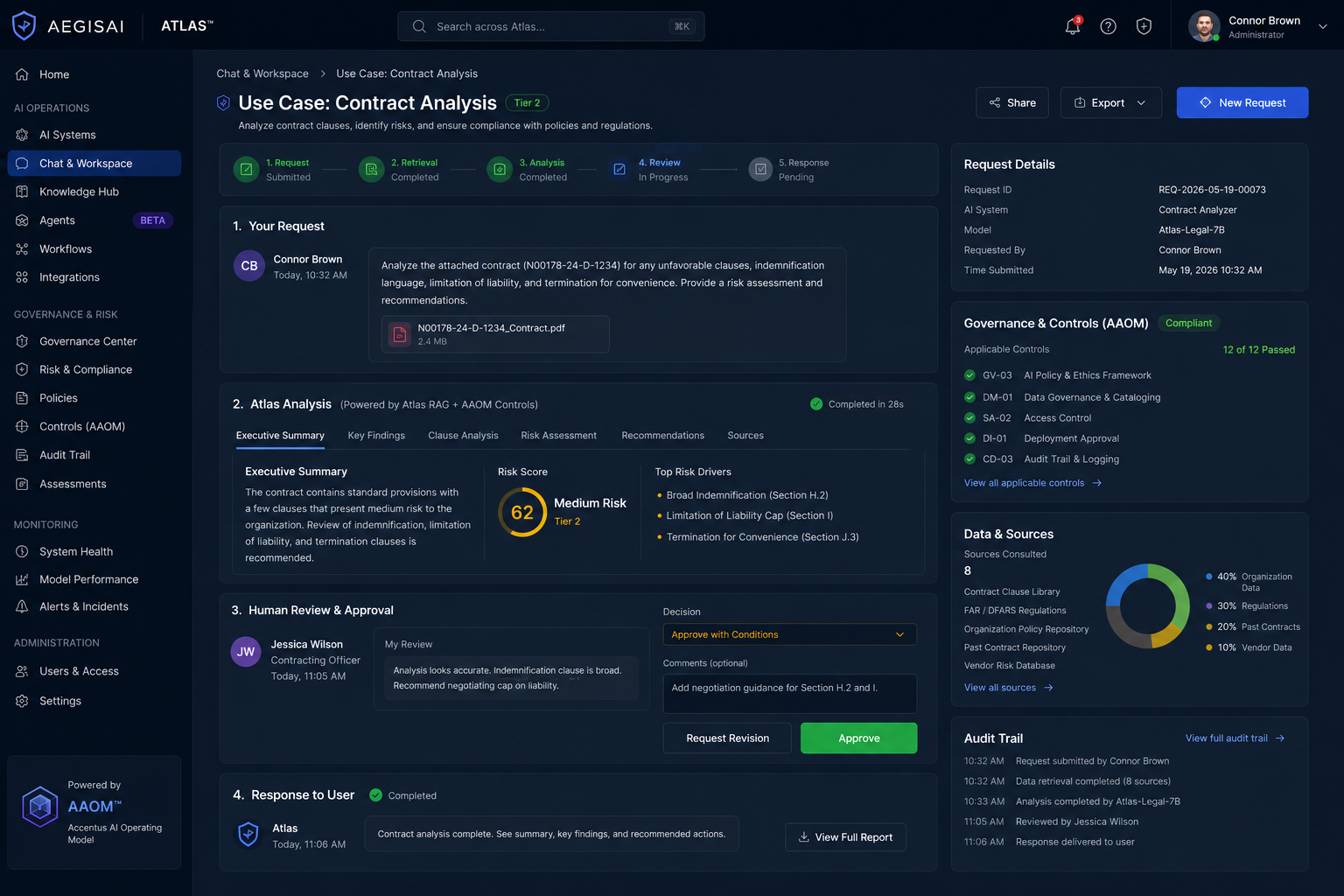
Governed Workflow Pipeline
Request → Retrieval → Analysis → Review → Response. Every step governed, every transition logged.
AAOM™ Controls Enforcement
47 governance controls evaluated in real time — policy compliance verified before delivery.
Human Review & Approval
Structured human-in-the-loop oversight with approve, revise, or reject decision workflows.
Risk Scoring & Audit Trail
AI-generated risk assessment with immutable audit ledger tracking every action and decision.
Concrete Workflow Outcomes
Every Atlas™ transaction returns an evidence-grounded answer—plus a workflow state, source attribution, and audit lineage. No black-box output.
“What are the escalation requirements for high-risk diabetic patients?”
- ┌ Care Protocol v2.1
- ┌ Clinical Escalation SOP
Logged • Reviewed • Citation-backed
“What clauses apply to this procurement threshold?”
Reason: Conflicting FAR interpretation detected across source documents
- ┌ FAR 13.003
- ┌ Agency Acquisition Supplement
Pending analyst confirmation
“Can Tier 2 engineers perform this remediation?”
Reason: Action exceeds Tier 2 operational authority
- ┌ NOC Runbook 4.7
- ┌ Operational Authority Matrix
Routed to Tier 3 lead for approval
What Enterprises Actually Fear — And What Atlas™ Eliminates
Organizations do not buy AI governance because they love governance. They buy it because they fear lawsuits, compliance violations, operational exposure, reputational damage, and regulatory penalties. Risk budgets are often larger than innovation budgets. Atlas™ directly reduces the operational risks that block enterprise AI adoption.
Unauthorized data exposure events
Identity-bound retrieval ensures every AI interaction is scoped to authorized data. No cross-boundary access. No accidental leakage. No ungoverned queries against sensitive corpora.
Hallucinated or fabricated outputs
Evidence-grounded retrieval with citation lineage eliminates AI-generated fiction. Every claim is linked to a specific source paragraph with confidence scoring. Provably real or provably blocked.
Reduction in audit preparation time
Every AI transaction is pre-audited with full provenance. When auditors ask "what did the AI do and why" — the evidence record already exists. No scramble. No reconstruction.
Regulatory readiness at the infrastructure level
AAOM™ maps directly to EO 14110, EU AI Act, OMB M-24-10, and state AI legislation. Atlas™ operationalizes the controls that regulations require — not as a checklist, but as enforced infrastructure.
Reduction in legal and compliance exposure
Every AI interaction is governed by policy, classified by operational state, and serialized with full provenance. This transforms invisible AI liability into a documented, defensible governance posture.
Days from pilot to governed production
Atlas Pilot™ goes from document ingestion to governed production workflows in 30 days — with full audit lineage, policy enforcement, and human review from day one. Not a POC. A production deployment.
Built for the People Who Fear What Ungoverned AI Can Do
These buyers do not purchase AI because they love AI. They purchase governance infrastructure because they fear lawsuits, compliance violations, data exposure, reputational damage, and regulatory penalties. Atlas™ is built specifically for the people whose job it is to reduce that risk.
CISOs & Security Leaders
AI creates an ungoverned attack surface — unaudited model interactions, uncontrolled data access, no operational boundary enforcement. Security teams cannot monitor what they cannot see.
Atlas™ enforces identity-bound retrieval, policy mediation, and immutable audit lineage on every AI transaction. AI becomes a governed, observable surface — not a shadow IT risk.
Compliance & Risk Officers
Auditors ask "show me every AI interaction, who accessed what, and what policy governed the output" — and today, no enterprise can answer that question.
Every Atlas™ transaction is serialized with full provenance: identity, retrieval scope, policy applied, operational state assigned, evidence grounding, and response delivered. The audit record exists before the auditor arrives.
General Counsel & Legal
AI-generated outputs are creating legal exposure — no evidentiary chain, no policy enforcement record, no proof that governance was applied. Liability is invisible until it materializes.
Atlas™ creates an immutable evidence layer for every AI interaction. Every output is linked to policy, source evidence, and operational classification — defensible in legal and regulatory proceedings.
Procurement & Vendor Risk
AI vendors cannot demonstrate governance infrastructure. Procurement has no way to verify compliance posture, audit capability, or operational controls during vendor evaluation.
Atlas™ provides the governance infrastructure that procurement teams can verify: AAOM™ framework alignment, continuous compliance monitoring, and auditable operational controls as standard.
Chief AI Officers & CAIOs
Federal mandates require AI governance frameworks (EO 14110, OMB M-24-10), but no compliant operational infrastructure exists to implement them. Policy documents do not equal operational controls.
Atlas™ is the infrastructure layer that turns governance policy into operational enforcement — workflow states, escalation routing, evidence grounding, and continuous compliance monitoring.
CIOs & IT Leaders
AI tools proliferate across departments with zero central governance, no unified audit trail, and no enterprise compliance posture. Every deployment is an island of ungoverned risk.
Atlas™ provides a single governance control plane for all enterprise AI interactions — identity-scoped, policy-mediated, operationally classified, and permanently audited across every department.
Every Transaction Is Mediated
Atlas™ routes every query through deterministic checkpoints—identity, retrieval scope, policy, evidence, classification, audit—before any response is returned.
The Biggest AI Risks Enterprises Face — And How Atlas™ Reduces Each One
Organizations do not buy governance because they love governance. They buy governance because they fear lawsuits, compliance violations, operational exposure, reputational damage, security incidents, and regulatory penalties. Atlas™ sits directly in the middle of these problems.
Unauthorized Data Exposure
Employees querying sensitive data. Confidential documents exposed. Retrieval crossing permission boundaries. Accidental data leakage.
Governed retrieval with RBAC/ABAC, identity-scoped access, and policy mediation on every transaction.
Hallucinations & False Outputs
AI invents policy language, wrong contract recommendations, incorrect legal interpretations, fabricated citations.
Citation-backed retrieval, evidence-grounded responses, human review workflows, and workflow-state mediation.
Lack of Auditability
Cannot answer: what prompt generated this? What sources were used? Who approved it? Which model responded? What policies applied?
Immutable audit lineage with full operational serialization — every transaction provenance-linked from query to response.
AI Agents Acting Without Oversight
Autonomous systems taking uncontrolled actions, unauthorized workflows, escalation failures, and operational drift.
Workflow states, approval gates, escalation routing, governance mediation, and human-in-the-loop architecture.
Compliance & Regulatory Risk
EU AI Act, EO 14110, OMB M-24-10, healthcare AI oversight, procurement governance, explainability requirements — all require provable controls.
AAOM™ framework maps to regulatory mandates. Atlas™ operationalizes the controls that compliance requires.
Reputational Risk
AI making bad decisions, exposing sensitive data, generating harmful outputs, bypassing controls. This is becoming a board-level issue.
Operational classification, human review gates, blocked states, and governance mediation — preventing harmful outputs before delivery.
Human Authority Is the Core Mechanism — Not an Edge Case
Competitors treat human review as a fallback. Atlas™ treats it as the operational primitive through which enterprise trust is established. Review queues, escalation approvals, blocked states, and analyst overrides are first-class infrastructure — not afterthoughts.
Ambiguous or conflicting evidence is routed to a human reviewer queue—not returned to the requester.
- TICKET-4081Conflicting FAR interpretation2m ago
- TICKET-4076Care protocol version mismatch6m ago
- TICKET-4068Vendor contract ambiguity14m ago
Actions that exceed operational authority are paused pending a manager or analyst approval signal.
- APPR-1142Tier 2 remediation requestPending
- APPR-1139Out-of-policy refundPending
- APPR-1135Privileged data extractPending
Out-of-scope or unauthorized queries are blocked and logged for compliance review—never executed.
- BLOCK-2204PII outside retention windowLogged
- BLOCK-2199Cross-tenant document accessLogged
- BLOCK-2193Unsigned model outputLogged
Every manual override is captured with reviewer identity, justification, and full operational lineage.
- OVR-0712Approved post-review citationJ. Patel
- OVR-0708Redaction adjustmentM. Chen
- OVR-0701Policy exception loggedR. Diaz
A New Category — Not a Better Chatbot
Every product below generates AI answers. None of them govern the operational lifecycle of those answers — how they are scoped, mediated, classified, routed, and audited. Atlas™ is the governance layer that sits above them all.
| Capability | Atlas™ | Enterprise | RAG | AI | AI |
|---|---|---|---|---|---|
| Workflow-state classification | Every response classified before delivery (Approved, Escalated, Blocked, etc.) | ||||
| Independent governance layer | Policy mediation decoupled from the model — not prompt engineering | ||||
| Immutable audit lineage | Full provenance: user → query → retrieval → policy → state → response | ||||
| Identity-scoped retrieval | RBAC-bound document access — different roles see different corpora | ||||
| Human-in-the-loop mediation | Review queues, escalation approvals, blocked states, analyst overrides | ||||
| Evidence-grounded citations | Every claim linked to specific source paragraphs with confidence scoring |
The category creator often becomes the perceived leader. Palantir defined data operations. Snowflake defined cloud data. Atlas™ defines governed AI operations — the infrastructure layer between AI models and enterprise trust.
Why Can't Incumbents Just Add This?
Governance is not a feature you add — it is a parallel infrastructure layer that requires end-to-end architectural control from identity through policy through classification through audit. You cannot retrofit it onto a chatbot any more than you can retrofit security onto an unsecured network.
Governance is architecture, not a feature
You cannot bolt governance onto a chatbot. Atlas™ was designed as a mediation layer from day one — identity, policy, state, and audit are structural primitives, not aftermarket wrappers.
Operational classification is a new primitive
No competitor classifies AI responses before delivery. Approved, Escalated, Blocked — this is a new operational construct that requires purpose-built governance infrastructure.
The evidence layer requires end-to-end control
Immutable provenance from query to response requires ownership of the full transaction chain. Prompt engineering and API wrappers cannot prove what they do not control.
Governance above the models — not inside them
Atlas™ governance runs independently of any language model. Model-agnostic. Deterministic. System prompts and fine-tuning cannot achieve what a decoupled policy layer enforces.
Human review is a first-class operational primitive
Review queues, escalation approvals, analyst overrides — these are not edge cases. They are the core mechanism through which enterprise trust is established and maintained.
Incumbents sell productivity — enterprises buy risk reduction
Microsoft, Google, and OpenAI optimize for response quality and speed. But CISOs, legal, and procurement buy reduced risk, audit readiness, and operational trust. Risk budgets are often larger than innovation budgets. Different buyers, different infrastructure, different market.
The Market Is Evolving — From "Can AI Do This?" to "How Do We Safely Operationalize It?"
Most AI companies still sell productivity, automation, and assistants. Very few sell operational risk reduction. That second category is much larger long-term — because risk budgets are often larger than innovation budgets, and the infrastructure to reduce operational AI risk does not exist yet.
Gartner projects AI TRiSM (Trust, Risk, Security Management) as the fastest-growing enterprise AI segment. The governance layer is where enterprise value accrues.
Enterprises have deployed AI tools. They have not deployed operational governance infrastructure. AI without governance becomes organizational risk.
EU AI Act. EO 14110. OMB M-24-10. 34+ state bills. Compliance is no longer optional — it is a market access requirement and procurement gate.
Chatbots generate answers. Copilots suggest actions. No product governs the operational lifecycle — scope, mediation, classification, audit — of AI in production.
Every major enterprise AI deployment eventually runs into governance, oversight, auditability, and operational control. That is inevitable. Very few companies currently own that narrative. Atlas™ is purpose-built for the operational AI risk reduction category — the infrastructure layer between AI capability and enterprise trust.
The Four-Phase Path to Category Leadership
Atlas™ is not building a product — it is building a category. Each phase expands the governance surface, from governed workflows to enterprise-wide AI operations to the industry-standard governance framework.
- •Evidence-grounded document intelligence with full audit lineage
- •Deterministic workflow-state classification on every transaction
- •Human-in-the-loop review, escalation, and analyst override
- •Governance layer extends across enterprise AI systems — not just Atlas™
- •Unified audit trail across every AI tool, model, and interaction
- •AAOM™ becomes the operational standard for AI governance posture
- •Governed action execution against operational systems
- •Multi-step agentic operations under deterministic policy control
- •Long-horizon plans bound to audit-grade lineage and human authority
- •AAOM™ adopted as the standard governance framework — like ITIL for AI
- •Atlas™ is the reference implementation that defines the category
- •Ecosystem of certified partners, auditors, and governance tooling
Industries
Built for High-Trust Operational Environments
Healthcare
Governed retrieval of:
- Care protocols
- Operational procedures
- Payer policies
- Workforce guidance
- Administrative intelligence
Government
Governed retrieval of:
- Acquisition workflows
- Policy analysis
- Compliance operations
- Mission-support documentation
- Procedural retrieval
Telecom
Governed retrieval of:
- NOC procedures
- Incident response
- Technical runbooks
- Escalation workflows
- Infrastructure operations
Financial Services
Governed retrieval of:
- Regulatory compliance
- Risk operations
- Credit analysis
- Internal audit
- Operational procedures
Why Atlas™ Requires Accelerated Infrastructure
Governance is not a wrapper around inference—it is parallel infrastructure that runs in-line with every retrieval. NVIDIA enterprise AI is the substrate that makes mediated, audit-grade operations economically and operationally viable.
Governance Mediation Latency
Every transaction passes through multi-stage policy and guardrail checks. GPU-accelerated inference keeps mediated routing sub-second even under enterprise load.
Real-Time Retrieval at Scale
Vector retrieval across millions of governed enterprise documents requires NVIDIA cuVS and Triton to maintain interactive response times.
Workflow-State Processing
Deterministic workflow classification (Approved, Flagged, Escalated, Blocked) runs in-line with synthesis—only accelerated infrastructure keeps this in operational SLAs.
Enterprise Inference Concurrency
Thousands of concurrent users querying governed corpora simultaneously. NIM microservices and GPU pooling deliver the concurrency regulated operations demand.
Audit Serialization
Every input, retrieval, mediation, and output is serialized into an immutable ledger. GPU-accelerated cryptographic signing keeps audit overhead invisible to the user.
Operational Orchestration
NeMo Guardrails, identity-bound retrieval scope, and policy engines run as orchestrated services—accelerated infrastructure is not optional, it is the substrate.
The Enterprise Trust Accelerator for AI Adoption
NVIDIA wants enterprise AI adoption at scale. But adoption stalls when organizations fear lack of control, lack of governance, and lack of oversight. Atlas™ is the governance layer that makes enterprise AI adoption safe — an enterprise trust accelerator built on the NVIDIA AI stack: